
A Party Without Direction: The Democratic Party's Existential Crisis
There's a reason we're fighting fascism without representation and without an actual resistance party

Dispatches From A Collapsing State desperately needs your support. This project enjoys no corporate backing and relies on your subscriptions. If this work helps you or resonates with you, please consider becoming a paid subscriber today
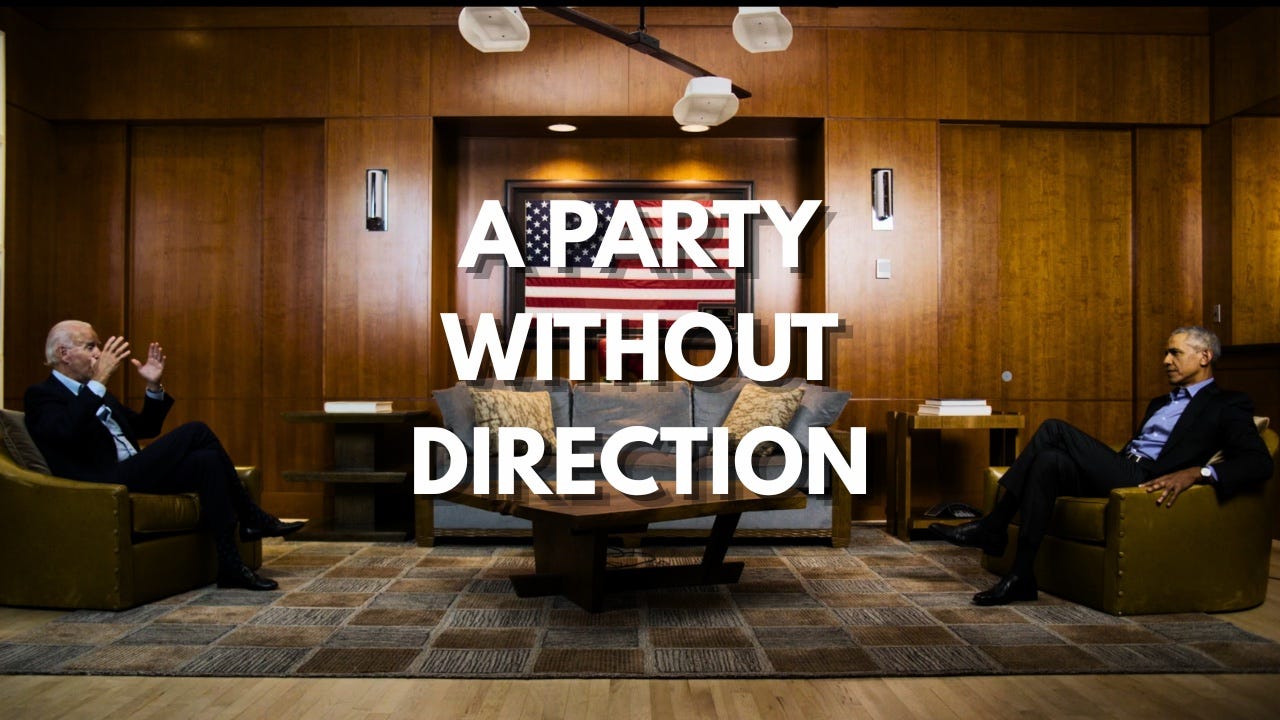
In the final chapter of the 2020 Democratic Primary for the presidential nomination, anyone with sources within the party had heard stories of how former president Barack Obama had begun pressing his thumb on the scale. As independent Bernie Sanders continued contesting and still enjoyed momentum and support, Obama wrangled the bloated field of candidates, letting contenders like Pete Buttigieg and Elizabeth Warren and others know that his former Vice President Joe Biden was the candidate the party needed to rally around. Once it became clear Biden would win the nomination, Obama continued to massage the race, pressing Sanders to “accelerate the endgame” so that Biden could build momentum heading into the general election.
Obama’s influence over the party since the end of his second term in 2017 has been elusive and, according to some of my connections within the party, somewhat vexing. Most of the time he is busied with a life of personal appearances, constructing his presidential library on the South Side of Chicago, and producing a nearly endless series of podcasts, documentaries, movies, and series with corporate partners like Netflix and Audible, but he still picks high-leverage moments to use his considerable influence and weight to direct the movement of the party. For those on the ground working to organize and elect candidates, it feels, and I paraphrase what someone has told me about the experience, like trying to build a town from the ground up only for the most ill-timed earthquakes to shake the entire project to the dirt.
Now, in the face of ascendant fascism, as the vast majority of Americans are desperate for the Democratic Party to not only represent them but to offer a strong, focused, and aggressive alternative to Trumpism and the even more dangerous movement that waits beyond him, and as approval ratings for the party in the face of their abysmal failure to do plunging numbers into the 30 percentile range, the frustration needs to be both addressed and the reasons why this has happened discussed.
The Actual Nature of Politics
Unfortunately, American education regarding the actual nature of politics has only helped to obscure the machinations of how power works and protects itself. We are given, instead, a narrative involving personalities and drama plays that are more like soap operas than examinations of incentives and actual maneuvers. This leaves us, like many who take to social media to react to every Democratic capitulation and disappointment and scream “What’re you doing???”, to exist in an environment where what is actually happening is hidden behind a veil of easily embraceable stereotypes while conditions continue to deteriorate.
With the Democratic Party, we are told it is a liberal or “leftist” party made up of mostly open-minded, educated people, and that the party itself represents the interests of a pluralistic coalition, including people of color, women, gay and trans Americans, immigrants, and working people. The party preaches tolerance and acceptance and continues to advocate for a kinder, gentler America in which progress continues. It’s easier to understand this by comparing it to a corporate brand. For example, Target, which, up until recently, portrayed itself as a bright, cheery, welcoming environment for families and even the LGBTQ+ community (before, of course, the Right attacked the corporation and then Donald Trump was elected to a second term and Target infamously pulled back from this depiction).
Behind the branding, the Democratic Party, like every party before it, exists to represent a coalition of stakeholders. Yes, the groups listed make up its “under base,” but the party itself is more beholden to a collection of wealth class donors and corporate partners who supply the capital necessary to maintain and operate a national party and an endless number of projects, including strategy, communications, and changing of the law to benefit those shareholders. The make up of both the Democratic Party and the GOP is determined, as is their agendas, by a constant struggle between the shareholders and the under base of supporters, creating an everpresent friction in interests.
This is how it has always worked in American politics. The paradigm shifts in our parties, including the creation of new parties and the destruction of others, has represented changing interests and changing capture of the parties. Sometimes the parties are more beholden to the shareholders, as they are now, and other times the under base asserts more control and/or rebels, causing the party to shift, adapt, or perish. Presently, the Democratic Party, in a time of existential crisis, is way, way more beholden to its shareholders, leaving the vast majority of Americans without effective political representation. This tends to happen, predictably, when wealth inequality reaches historic levels and corruption spreads like a cancer.
Tracing the history and direction of a party like the Democrats requires examining who the shareholders are, how they have shifted, and ultimately, what entrenched machines control the relationships and direction of the party.
How It Works
Once again, these trends have played out throughout our history. Sometimes a party (let’s just call it the Freedom Party for our purposes) is beholden to a certain group of shareholders. In this example, the Freedom Party is a 20th century political group that has a strong partnership with telecommunication corporations that gained immense power and wealth as access to telephones spread across the country. The money amassed and influence gained makes it a logical partner for a party looking for investment. Meanwhile, the Freedom Party has an under base of labor unions and rural voters. That party, through the planning and efforts of its leaders, would likely prioritize legislation that helped its telephone shareholders expand their businesses and gain more power and wealth while possibly helping its labor union and rural supporters, sometimes even synthesizing these efforts by doing things like offering more access in more rural areas to telephones. All the while, the party would do its best to arbitrate disputes between its labor union supporters and the telephone shareholders.
Eventually, however, as the telephone company gained more money and power, thanks to its party partnerships, they would use these gains to influence the party more, buy candidates, and tip the scales. The party would, if not constantly aware of the contradictions, maybe even pass legislation that would hurt rural voters and would undermine the labor unions in negotiations with the shareholders. Dissatisfaction would grow, the under base would get tired of the treatment, and, as things changed economically, they might tend to move toward another party that offered them more while also being tied to shareholders who weren’t explicitly opposed to them, or at least, seemingly so. They might abandon the party, they might struggle to change the party, and, possibly, if the paradigm shifted enough, a new party might emerge that would offer a different partnership. Say, I don’t know, a party affiliated with coal mining / energy companies, etc.
All the while, what is presented, beyond these material conditions and incentives, is a pleasing facade with speeches talking about “the American dream” and promises to make things somewhat better for the under base. Star-spangled bunting and all that. Songs. Advertisements. Figures and personalities and heroes. But, at the core, these interests are driving the show.
Shifting Machines
Prior to Bill Clinton’s election in 1992, the Democratic Party was somewhat lost. Since the collapse of the New Deal Coalition surrounding Franklin D. Roosevelt, the party had merged an under base of labor unions, people of color, women, and the working class with a series of regional powerhouse machines like the Daley political machine in Chicago. Then, Clinton and associate Al From seized national control with their work in the Democratic Leadership Council, which embraced Neoliberalism following Ronald Reagan’s landslide victories in 1980 and then 1984, proposing the party needed to move beyond pure representation of the under base and toward corporate partnership and “free market” ideology.
Clinton’s machine held the reins for roughly twenty years and saw a spate of Democratic politicians get elected following this “third way” ideology that essentially saw the party embrace Neoliberal capitalism and finish the project of global capitalism, which Clinton inherited from Reagan, George H.W. Bush, and the Neoliberal machine that controlled the GOP at that time. For someone to receive the full support of the party in a Congressional race, to get chosen and then backed by the Democrats, it meant fealty to the overall project. Meanwhile, the Clinton Machine fostered relationships with corporate shareholders like finance firms, energy powerhouses, telecommunication giants, and the type of corporations that benefited from global free trade and started to emerge as companies that existed in multiple countries. If you understand this, you understand why global free trade happened, why telecommunications was deregulated, and why the “economic boom” of the 1990’s both led to an amassing of incredible wealth and power by a select few while many Americans saw their lives turned upside down.
In 2008, Barack Obama effectively overtook the Clinton Machine when he wrested the party’s nomination from Hillary Clinton after an ugly and divisive battle. Obama was able to do this, in part because of his own personal talent, but also because the Democratic Party’s contradictions had grown so large that it was vulnerable. The agenda he ran on tirelessly critiqued the damages caused by the Clinton Machine on behalf of its shareholders, including support for the Iraq War and War on Terror, the devastation of life in Middle America, growing inequality between the under base that had been harmed and the elites that had been served by the machine, and essentially offered a shift that could address these consequences. When Obama won, he didn’t just win the nomination. With the support of his closest allies and a new set of shareholders, he installed a new machine to control the Democratic Party.
Obama’s shareholders included parts of the original Clinton Machine, which is why not all that much changed, but also counted a new generation of tech industrialists and corporations on the upswing. Obama’s Machine partnered with the exploding tech industry, creating partnerships with corporations like Google and oligarchs-in-waiting like Jeff Bezos and Elon Musk. The Obama Administration, and the Democrats downstream from Obama, believed these tech elements were natural partners in not just a new economy but a progressive America. The party refused to regulate big tech, shoveled as much money and as many resources as possible to these elements, and continued to shift power and wealth in the country in their direction.
This, unfortunately, is how the tech class became a class of tech oligarchs. These shareholders were never actually interested in progressive politics or moving the country forward. Predictably, they only cared about market control, consolidation of power, and the creation of a new economy under their control and a government they could increasingly buy.
Stalled Transfer
Because Obama maintained control of the party, the machine is still in place despite obvious conflicts. The tech oligarchs his machine created turned from the Democratic Party at the first moment it was convenient while maintaining enough of a financial hold over the party in order to placate any resistance. This is why, unfortunately, rank and file Democrats still can’t really critique Musk or Bezos or offer regulation of AI. Their shareholders are still, to some extent, populated by the very people and very corporations that are attempting to destroy democracy.
It’s telling that Obama personally handpicked Hillary Clinton as his successor in 2016, telling Biden it was her turn and advising him not to run, and then helped to curb Sanders’s challenge in the process. When Biden won in 2020, Obama helped facilitate it and many members of his personal braintrust continued their work in that administration. Then, Biden bowed out in 2024, and who was there to help Kamala Harris and to help direct the hastily put together operation? The Obama folks.
Meanwhile, those in Obama’s circle used their connections with the machine’s shareholders to secure lucrative jobs on the boards and within the corporate structures of the tech oligarchs they helped to create in the first place. This is why Obama stalwarts like David Plouffe and Jim Messina end up getting paid handsomely by corporations like Uber. Then, when they return to Democratic politics, their advice and strategy reflects the corporate interests of the business that actually pays them more money than the Democratic Party, because it is essentially insider-lobbying. What do you get? A Harris Campaign that never really mentioned the growing power and influence of the tech oligarchs, that never dared to challenge the worsening status quo, and a celebration of Wall Street. Because the Harris Campaign was nestled within the Obama Machine, helmed in part by Obama Machine veterans, and still dedicated to the shareholders that were actively making conditions worse.
There was no Biden Machine. There was no Harris Machine. Even as the tension between the under base and the shareholders grew, there was no political force there to represent that under base and potentially new shareholders to trouble the grip on the party and change the paradigm. Working within the Obama Machine were gatekeepers like Chuck Schumer and Nancy Pelosi (who was just honored at the Obama Presidential Library with her own garden pavilion for her role in the machine) maintained discipline in the choosing and supporting of Congressional candidates and then, by extension, their votes within the halls of power. And to do what? To advance agendas that occasionally helped the under base in marginal ways but mostly took care of shareholder interests.
In a way, the Democratic Party has suffered because of just how powerful and effective the Obama Machine has been, even as Obama has largely receded from politics, his allies have increased their links and strengthened their relationships with shareholders, his under bosses at the congressional level have been so competent at enforcing machine loyalty, leaving the party to become less popular with its under base and less attractive to potential voters looking for alternatives to the status quo.
Choices
Describing this paradigm can be paralyzing. We don’t have the money the tech oligarchs have. We don’t have that influence. The under base cannot spontaneously become more important than the shareholders, that’s simply not how this works. And, it should go without saying, we can’t just hope and pray that the party will suddenly “come to its senses” because that’s not where the incentives or influence is.
It is only through antagonism between the under base and the party regarding the shareholders that can shift a party and/or reveal the need for energy to be directed elsewhere. Projects like the Progressive Movement and the New Deal Coalition, which were so effective they took over both parties and shifted the consensus for decades apiece, didn’t emerge out of nowhere. They happened because regular people organized, antagonized, and pressured the parties to change to meet their demands. And, in both cases, these movements were subject to periods of historic inequality and unparalleled corruption, which required a changing of tactics. Eventually, the machines took over the parties, restructured their operations, forced a shift in ideological direction, and changed the course of history.
Doing this now depends on a few things. One is local and regional organizing that stresses material conditions that are not being addressed by the national parties. Luckily, that’s basically everything at this point. This means tackling poverty, social injustice, calling for expanded rights and protections, demanding larger systemic change rather than modest reform, and, perhaps most importantly, pursuing a necessary confrontation with the wealth class, oligarchs, and the collection of shareholders that control the parties. This must include dispatching of tried and true narratives and stereotypes, recognizing, like Obama did in 2008 with his own takeover, that the machine in place has made definitive mistakes that must be addressed. The Democratic Party helped create the oligarchical class, gifting burgeoning tech industrialists and their corporations too much money, too much power, and too many blank checks. This doesn’t mean you have to dismiss any good that Obama or members of his machine completed, but it does mean being clear-eyed about where they fell short and what the actual reasons are that those failures occurred.
Either the Democratic Party will change or it will give way to something else. We have seen this cycle play out so many times, and the divide between the under base and the shareholders is always a driving reason in why it happens. With each passing year, the current structure of the Democratic Party proves not only disastrous but also untenable. The under base is being targeted, betrayed, and, through the ravages of fascism, liquidated. If this continues, there won’t be an educated middle class of professional managers to rely on. There won’t be labor unions. And marginalized communities like people of color, women, gay and trans people, and immigrants will turn away from a party that doesn’t serve them like the working class already has.
Luckily, this isn’t something we simply have to sit back and watch. We can clearly see where things have gone wrong and where things need, to borrow one of Obama’s most cherished words, to change.
Thank you! I always learn so much from your work, it’s like eating a very nutritious meal. Glad to be a paying subscriber!
Excellent analysis.