

It was a rough week for the Democratic Party. But, then again, most weeks now are hard weeks for the Democrats. For awhile now there have been whispers that have grown into open rumors regarding the direction of the Democratic National Committee. Hardly a meeting or call would go by without someone mentioning “the money.” Namely, that the DNC has none. And, then, someone would say something about “Ken,” usually in reference to Chair Ken Martin needing to update his resume.
On Sunday The New York Times finally published an article a lot of us have been waiting on for some time now. In it, Martin was predictably portrayed as a sinking ship, a paranoid, failed manager reduced to screaming at employees, slinging his cell phone at their desks, and mismanaging the DNC while forcing one person after another to sign NDAs. The cash situation was finally revealed to the public and it’s bad, so bad that the DNC has taken to asking vendors to bill them after the Midterms. The money gap between the Democrats and Republicans is staggering. $2 million in debt for the former, well over $120 million for the latter. Hoping to get ahead of the whole thing, Martin started a Substack last week that has only published one sweaty and desperate excuse for the disaster.
Meanwhile, in Michigan, the scene got uglier. Rep. Haley Stevens received the endorsements of Governor Gretchen Whitmer and South Carolina Rep. James Clyburn. It’s been awkward, at best. Whitmer’s stock has collapsed and she’s currently trying to sell Michigan on data centers that no one wants. To help the situation, and to fend off challenger Abdul El-Sayed, nearly $30 million in AIPAC money has been injected into the campaign. Then, an operation to pay social media users and influencers $1,500 per post in support of Stevens was uncovered. Oh, and Stevens was forced to fire Caitlin Legacki, a consultant, when it was revealed that Legacki also counted Palantir among her clients. Not to mention that Stevens’ campaign has taken a notable and ugly turn as she works with establishment Democrats to ward off an insurgent candidate who wishes to move the party left.
The debacle in Michigan is just yet another instance in a long line of moments where the existential dilemma of the party is being exposed. And this intraparty fight is revealing something much more important than the dynamics of the Stevens / El-Sayed matchup, just like the struggles at the DNC are about more than money and Martin’s tenure.
The Bleed
Political analysis has a tendency to suffer from a lack of context and large-picture consideration. Politics tends to function as a mad scramble that moves from one election to another in two year sprints while abandoning larger trends, all while the march of history continues on and the world itself changes with every passing day. The DNC story becomes one of mismanagement. The Stevens affair just something that happened. Conversation focuses on polls and election predictions. What I’ve called “Chuck Todding” is the norm, which helps explain why the former host of Meet the Press has started paying his bills by offering viewers value bets on FanDuel’s prediction market betting. Instead of a fight for the betterment of society and a life and death struggle, it becomes sport and the human element is all but erased.
We are in the middle of a historic political realignment that goes much deeper than what happens in the November Midterms, if they are to even happen or be even remotely free and fair. Both the Democratic and Republicans parties are changing as the country changes. Continuing to treat this with stereotypical analysis is not only wrongheaded, but, with the rise of authoritarianism and worsening conditions, abjectly dangerous.
The battle between Democratic centrists and the Left, which has been intentionally characterized as being between Democrats and the Democratic Socialists of America (DSA), is about more than which candidates will be on the ballot in November. It is a symptom of this realignment and the large material and political change we’re experiencing.
Presently, the Democratic Party is hemorrhaging support.
The reasons are many, including a failure to properly oppose the rise of Trumpism and fascism and continued allegiance to corporate and wealthy donors over constituents, but it also boils down to the material and class changes within the United States. Rank and file members are doing their damnedest to undercut leftist challenges and, as anyone paying attention with objective perspective can tell you, it is a signifier of a problem much, much deeper than whether someone like El-Sayed wins the nomination.
We’ve entered a new chapter in our political cycle and hardly anyone wants to see it for what it is.
The Actual Political Spectrum and Party Structures
Lazy framing wins out because it’s simpler and quiets the harder and more uncomfortable aspects of politics. I can’t read an article or post about “the Left” when referring to Democrats without getting increasingly more frustrated. As I’ve said over and over, there has been no “Left” in this country for a long time as it has been undermined and destroyed, at least not in an organized fashion. That does appear to be changing, or is attempting to change. Here is what is sold to us in general discussions of politics within the media and by the political class.
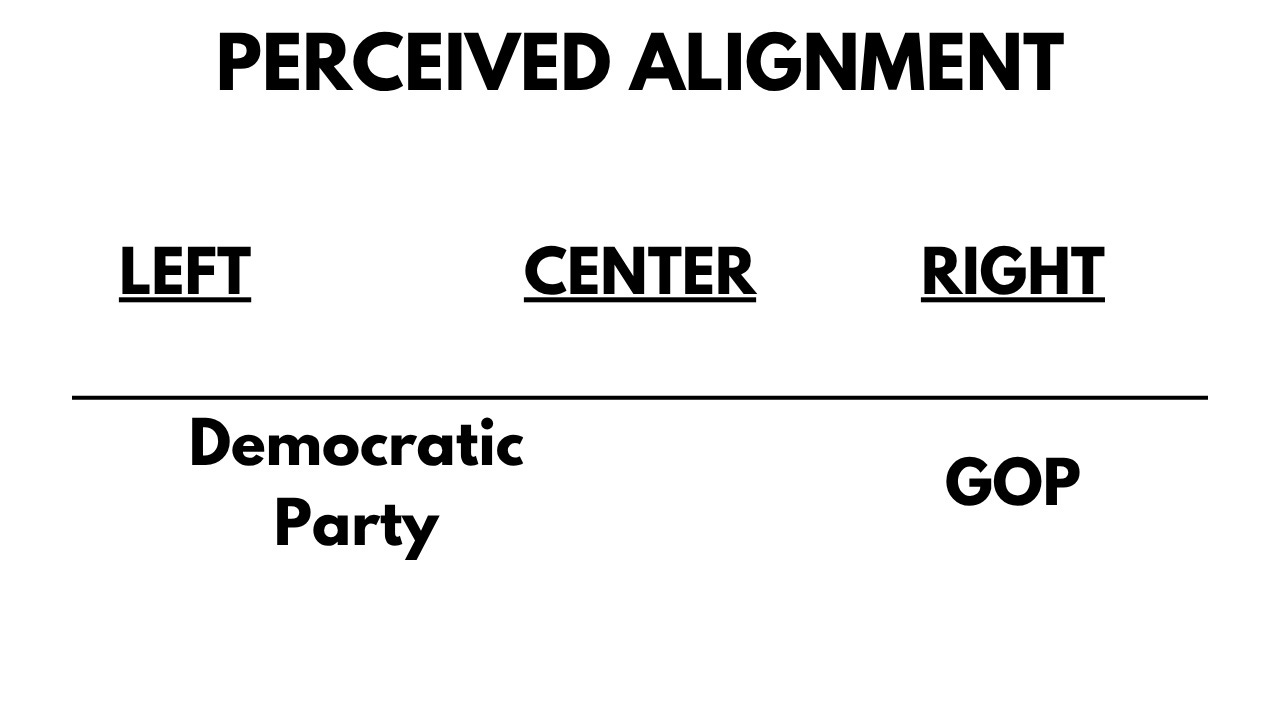
In reality, the spectrum of our politics spans from the center-right to the far-right. The Democratic Party has effectively become a conservative alternative to the far-right, radicalizing nature of the GOP as it has become more and more fascistic. There is no Democratic Party agenda for large-scale change, merely a promise to preserve what remains after years of Republican dismantling. Occasionally there is discussion of infusion of wealth into the broader population (only when capitalism requires injections to stabilize its contradictions and avoid collapse), taxing the wealthy (though this rarely goes forward), or modest reform (this goes nowhere as a rule), but the general dynamic is a conservative party squaring off against a far-right party. Add to that the fact that castoff Republicans who helped create the modern GOP have left their party and joined the Democrats and they simply will not stop telling Democrats to “moderate” as they have become, inexplicably, some of the most popular and sought after commentators.
Beyond that, our actual alignment looks more like this:
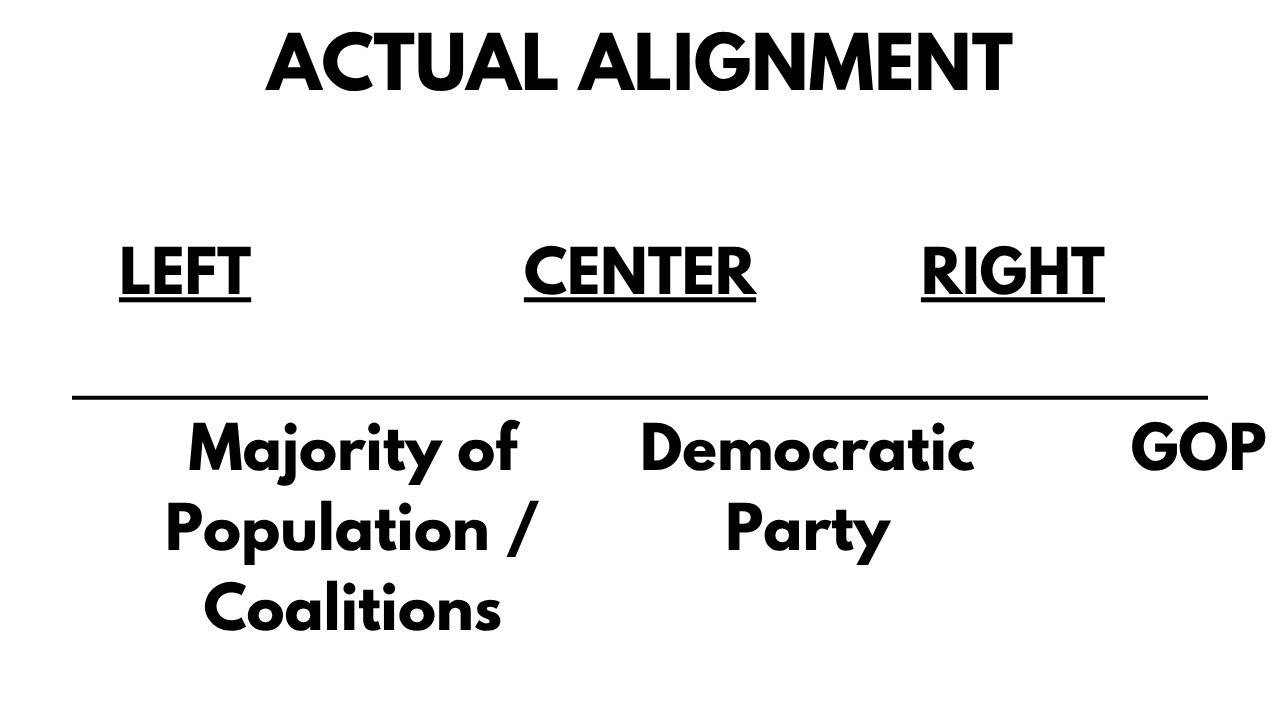
The work of public-facing politics, as we have experienced, is to muddle the perception and to present to the public an “acceptable” span of political options. Stories and issues that are presented by corporate media communicate a narrative in which a host of specifically designed wedge issues give the appearance of a near 50/50 split (or, in some cases, a 45/45 split with the remaining ten being “independents” that need appealed to by the Democratic Party) while these issues, i.e. trans athletes in women’s sports, obscure a broad majority across political affiliation. Discourse is always directed away from this reality. It’s not “acceptable” to have robust and serious conversations about redistribution of wealth and resources, although that’s what voters are actually looking for. Geopolitically, there is very little distance between the parties as they are both dedicated to the pursuit of the American global project because it is, and here is the rub, serving capitalist whims. Domestically, the issues that are mostly hidden and obscured by designed wedge issues, are, once more, serving capitalist whims.
As wealth accumulation has grown, members of the Wealth Class and the eventual Oligarchical Class, which evolved from the redistribution of tens of trillions of dollars, have continually bought off politicians and eventually the parties. Each party is beholden to wealth stakeholders and corporate partners. As you can see below, most are shared.
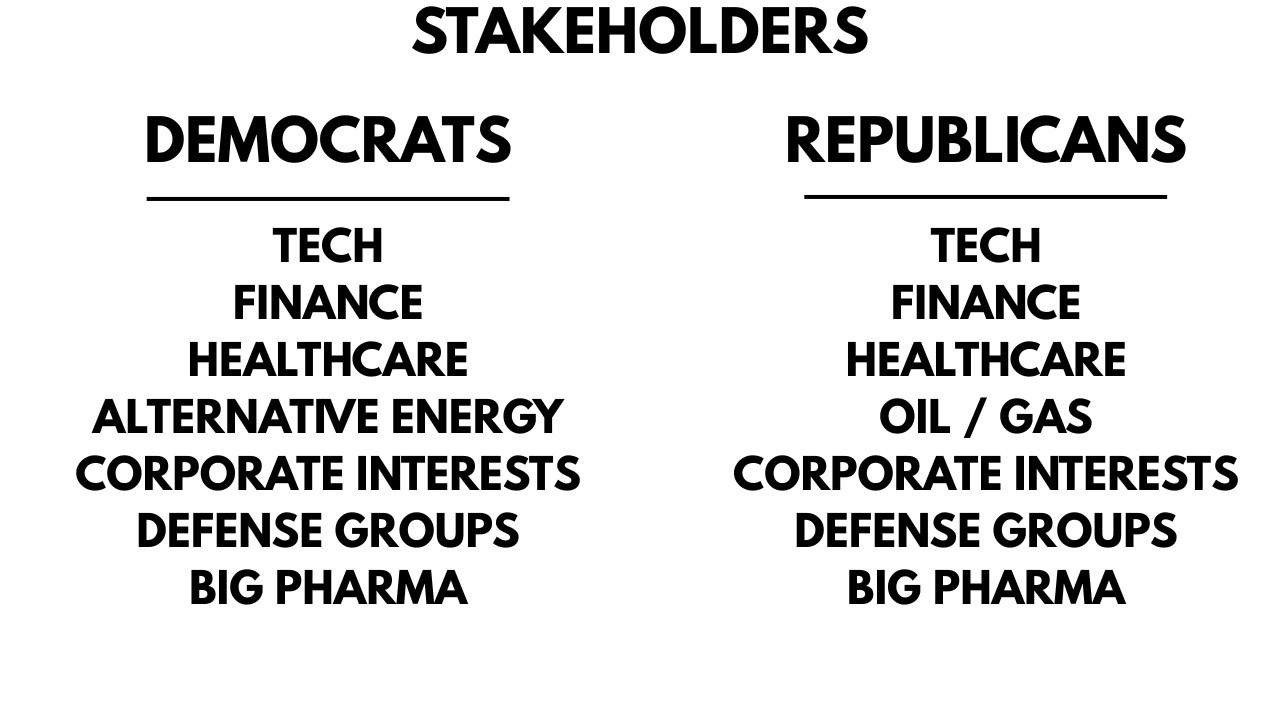
These are very broad categories, obviously, and within each of them there are competing interests and capitalist blocs seeking to shift this policy or fine tune another to gain more an edge, but for the most part there is a virtual consensus on maintaining the status quo and present trajectory. Or, at least, the spectrum of discourse and debate that are considered “acceptable” at the legislative level and within corporate controlled media.
Here, in this example, you can see the main outlier: energy. This is why there is almost no consensus whatsoever when it comes to how our politics should move forward when it comes to climate change and why there is such a gap in worldview from the parties. The last major domestic battle, if you remember, was the introduction of the Green New Deal, which caused so much turmoil because the plan lay square in the middle of one of the dividing points between the parties. Rather than informed debate, we’re given moralistic framing that hides the material interests.
Another example: the Affordable Care Act. The fight over ACA was massive and seemed like a battle between the Democratic Party attempting to overhaul healthcare industry and the whole of the healthcare industry opposing it. However, a deeper examination finds that different factions within the industry fell on the separate sides. Massive Insurance companies, hospitals, and pharmaceutical companies partnered with the Obama Administration to create the legislation (based, it should be noted, off Republican Mitt Romney’s plan in Massachusetts) because it ensured them of a flood of new customers. On the other side: smaller insurers that might not survive protections for preexisting conditions and the medical device field that was initially hit with an excise tax before the GOP repealed it in 2019. Instead of this being the focus of political discourse, specifically which interests were being served, it became a fight between “socialism and liberty.”
This set-up is why even issues with broad, super-majority consensus in opposition, like A.I. (which is despised by something like 75% of Americans), data centers (opposition hovers around 70%), and ICE (its approval rating is roughly 30%) retain support by both parties with notable exceptions. Then, something like universal healthcare, which newer polls show upwards of 70% of Americans believe would be good and necessary, is something that is conspicuously absent from the party platforms.
Below the corporate partners and stakeholders, which largely control the legislation and platforms of the parties, there is a sub donor level that looks like this:
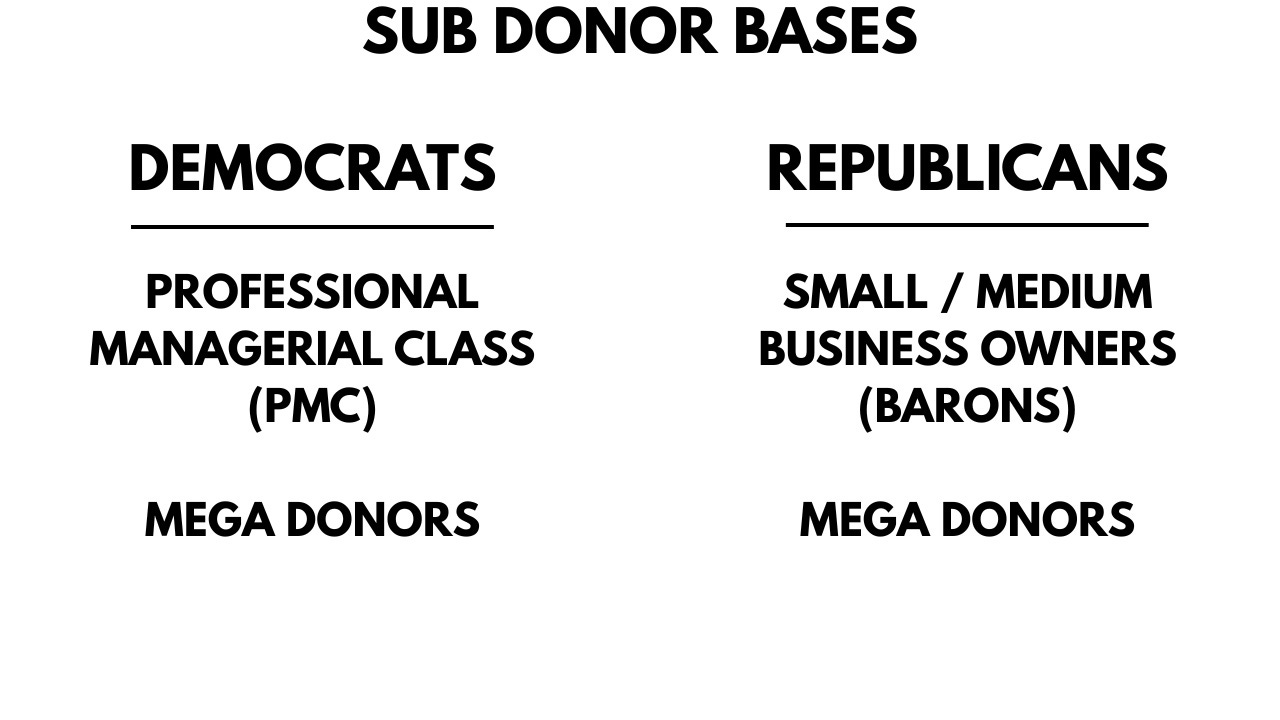
The Democratic Party shifted in the late 1980’s and specifically in the 1990’s away from its union labor base and toward corporations and what has been called the Professional Managerial Class (PMC). This is a college-educated group that holds positions within management of corporations and institutions like higher education. The GOP is backed, at this level, by small and medium business owners who are locally or regionally powerful (think the owners of a franchise of automobile dealerships) but resent the power of national and transnational corporations. For reference purposes, we’ll refer to them here as Barons. The GOP, sometimes successfully and sometimes unsuccessfully, attempts to balance the contradiction between, in this case, the Wealth and Upper Middle Classes with the Oligarchical class, which is where you see some of the dysfunction and discord within the party.
Below the sub donor bases are the voting bases, which are extremely polarized and, it should be mentioned, are where most of the designed “wedge issues” are employed in order to obfuscate larger class-based interests.
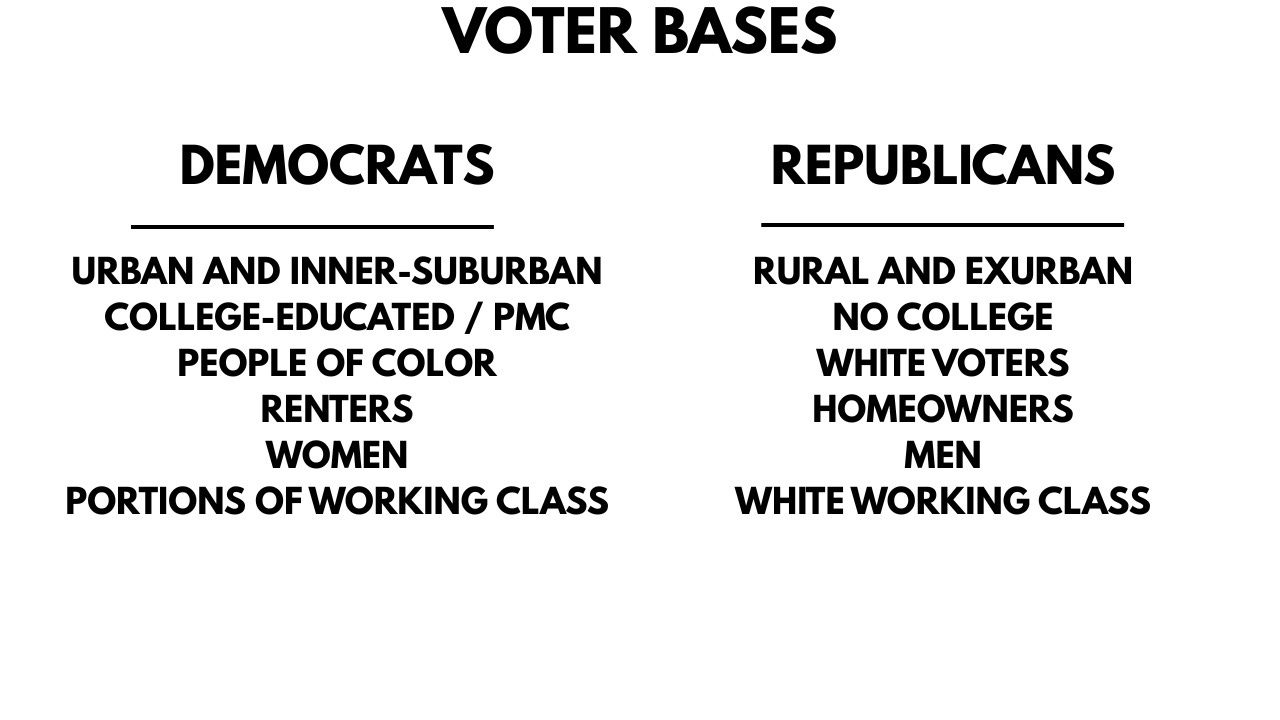
While the Democratic Party’s voter base is much more diverse than the GOP’s, the latter has the advantage of largely having a cohesive worldview or narrative that is often strung together, and predictably radicalized, through the use of prejudices and fearmongering. While the Democratic Party, as the conservative party, intends to hold together the status quo, the Republicans tap into a deep-seated fear that the world is changing in dangerous ways. Because of this, the contradictions of the GOP, namely in how the stakeholders are always represented, the sub donors mostly represented, and the voter base largely betrayed, are navigated by continually communicating an existential crisis in which certain apocalyptic doom is inevitable if the voter base doesn’t support the party.
Of course, the Democrats have their own version of this. While promising to fight against Trumpism and fascism, they have maintained some support at the polls, but the dissonance between what the party says and what it actually does is much, much more palatable as the GOP is allowed, because of dynamics and psychology, to behave aggressively while the Democrats are kept in a conservative posture.
This, naturally, creates a tension that is wrenching the Democratic Party, and to a lesser extent the GOP, apart.
Material Conditions and the Radicalized Orphans
It is predictable when tracing the trajectory of corrupted parties that serve capitalist markets to see a point at which the public-facing structures and the internal incentives come to a boiling point. For the Democratic Party, it is untenable to serve the interests of corporate benefactors while satisfying the voter base, especially as conditions continue to deteriorate. Lacking a base-level motivator, like white, patriarchal terror, all that’s left is a recent history of disappointments, which is why the Democratic Party’s approval rating (between 36% and 40% depending on the poll) is roughly equal to the GOP’s, which is seen as historically unpopular and dangerous, even while the electoral makeup of our institutions gives the Republicans a built-in advantage.
To make matters worse, the gobbling up of resources by the wealth and oligarchical classes is being fueled by the destruction of the social safety net, plundering of public wealth, and the destruction of standard of living. While the Democratic Party depends on white collar support, the Middle Class is being effectively liquidated. Its reliance on college-educated voters is notable as enrollment drops because of affordability and the end of guaranteed employment following graduation. Fold A.I. into the mix, which has promised to eliminate upwards of half of all white collar jobs, and you’ve got a real problem.
A growing number of Americans rightfully feel unrepresented by the major parties. This is not limited to the Democratic Party as the GOP is going through its own changes even while many continue to believe it is a homogeneous body. This has created a class of voters that is going largely unseen and misunderstood. I call them the Radicalized Orphans.
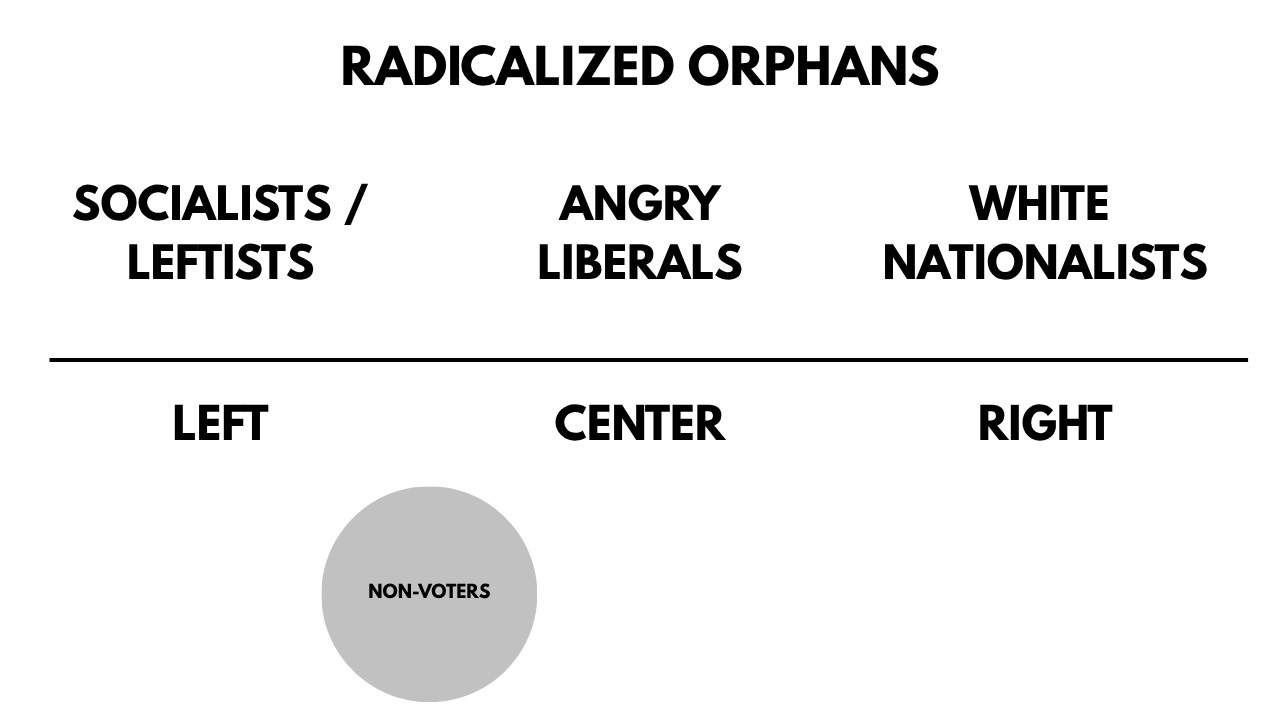
Within this group are a variety of individuals and organizations that have reached a point of dissatisfaction with the parties in which they are either openly questioning them, working against them, or have given up on politics altogether. Their ideologies are disparate. Some are dedicated Leftists and Fascists and informed at varying degrees. Some are confused. Some simply don’t care.
Socialists and Leftists are defined by a desire to redistribute wealth, resources, and control to differing degrees, including some who wish to the New Deal Era (which was a capitalist fix in the shape of limited Democratic Socialism), and most to break the duopolistic, capitalist hold I have described. Fascists and White Nationalists want to change the status quo in the favor of their own defined “in groups,” including white men and Christians, and many want to see a shift in power from urban to rural and overtaking pluralistic society as a cultural revolution. Angry Liberals are angry at both the Democratic Party’s unwillingness to addressing material conditions and resist the fascist direction of the country and, increasingly, irritated by the party’s frustrated lecturing as to their reality being “imagined” or “hysterical.” Non-Voters, pictured here to the left but spanning the spectrum, have simply become so disillusioned by the entire thing and, for a variety of reasons, have stopped voting and paying attention.
Considering these groups are now either politically homeless or battling with the parties for control, the actual political spectrum looks, and yes, this is a bit rudimentary, but still, more like this:
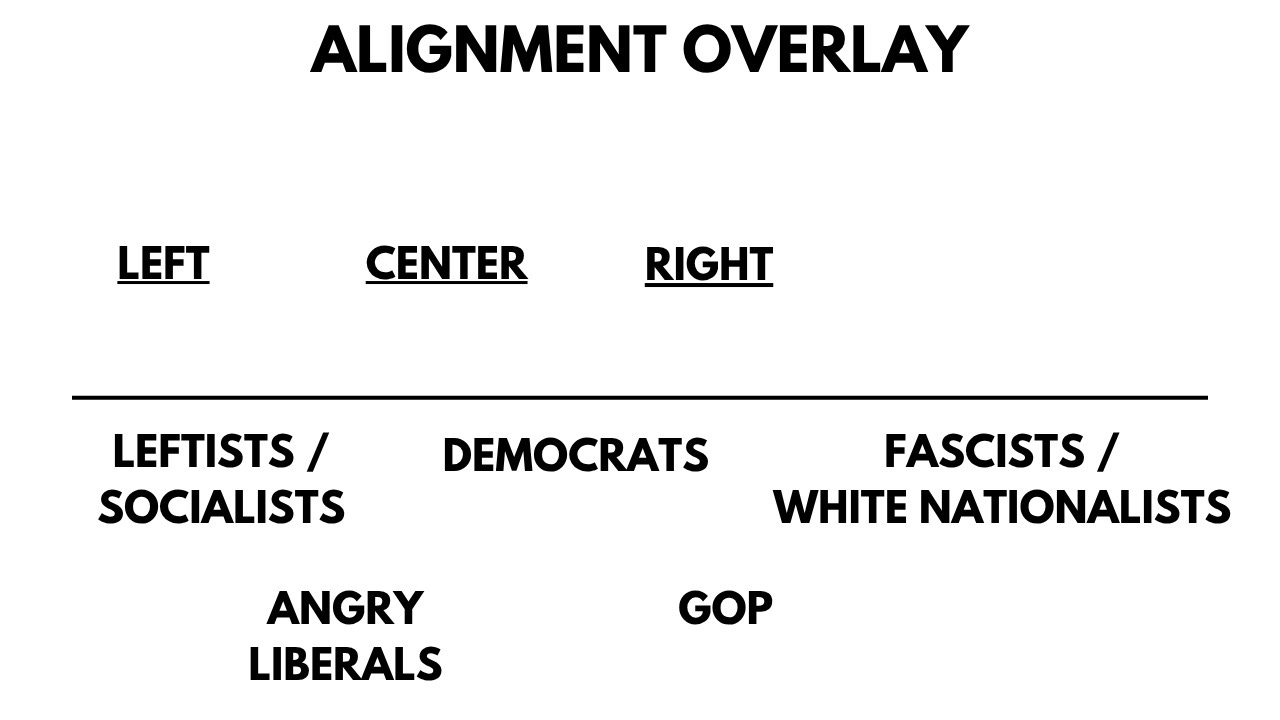
Presently, the Leftists are attempting to drag the Democratic Party to the left and Angry Liberals, through their critique and either enthusiastic or reluctant alliance with the Leftists, are attempting to pull the party at least to the actual center. Fascists and White Nationalists, particularly those who see Donald Trump and MAGA as too moderate and as failures, seek to emphasize the authoritarian elements of the project and do away with the contradictions. Considering these Political Orphans as a collective make up a majority of the population, eventually something has to give.
Realignment
What we can be sure of is that, as long as this paradigm persists, and all financial incentives are so determined as to make this paradigm continue, more and more people will join the class of Political Orphans. This can happen through dissatisfaction and material conditions worsening, including precarity growing and with the liquidation of the Middle Class, increased pressure on the Working Class, and growing exploitation of vulnerable populations, including people of color, the poor, women, the disabled, immigrants, and the LGBTQ+ community. What you get are a lot of pissed off, dissatisfied people and an unresponsive political system and environment. This tends to get very weird and very dangerous.
Leftists and Socialists will continue challenging the Democratic Party and pulling it left unless party apparatus doubles and triples down on undercutting them, which will further alienate the organized bodies like the DSA but also supporters within the population. Angry Liberals will either become Leftists and Socialists, Fascists and White Nationalists, or will throw up their hands and become Non-Voters. The Fascists and White Nationalists, unfortunately, have an advantage in that the GOP is actively cooperating with them and are presently sliding downhill into full alliance and an embrace, and no information or data suggests that’s going to slow down. Non-Voters, depending on whether certain ideologies change the parties, or depending on conditions, could suddenly re-engage and join either the Leftists and Socialists or the Fascists and White Nationalists.
Meanwhile, the voter bases, as established, will change as well. If the Middle Class continues to be liquidated, and more than likely they will, their conditions will deteriorate and they will join these Political Orphans. An example of this, and a very telling previous cycle, is the shift in 20th century Germany from the Weimar Republic to a battle between Communists and the National Socialist Party, which won power in part because the white Middle Class that had previously found Adolf Hitler repugnant embraced him as conditions worsened. Here, in the United States, there’s still a large possibility that sections of the Middle Class we now refer to as “Centrists” though they are on the right-side of the spectrum will in fact join the Fascists and White Nationalists should conditions deteriorate.
Presently there are many large vacuums that must be filled. Trump and MAGA gained power in no small part due to a maneuver I’ve come to call the Fascist Feint, which is where an absence of leftist critiques of capitalism among conservative liberals (i.e. the Democrats) opens the left flank and allows the Right to provide a facsimile of leftist critique that people yearn for and then do the bidding of the Wealth and Oligarchical classes. That feint will only continue and strengthen, especially as the Right moves beyond Trump and uses him as an example of captured opposition while promising to actually Make American Great Again. Already we are seeing fascist job programs in the form of ICE take root. The Democratic Party is actively shedding support by Angry Liberals and Socialists and Leftists and their voter base, to a group, is experiencing worsening conditions, threatening that they might move either left, right, or join the Non-Voters.
There’s a reason the Democratic Party is broke right now. Its voters are tired of giving money with no payoff. Instead of listening to their base, the party is relying even more heavily on corporate stakeholders and mega donors to fill their coffers and operate outside the party and in the shadows, creating campaigns like Stevens’ where support and enthusiasm is having to be manufactured. Likely, we will see even more institutional maneuvers like the efforts to block Bernie Sanders from the party’s nomination in 2016 and then 2020, which will only ostracize more supporters and move them into one of the other Political Orphan camps. It is likely, if that is the case, we will also see the Centrist Democrats embrace increasing surveillance, censorship, and oppression by state power pushed by the authoritarian Right and that, it should be obvious, will also alienate supporters. When you enter this part of the cycle, self-destruction tends to become the norm.
However it plays out, the political realignment will be powerful and transformational. In the 20th century alone we saw several, including the rise of Progressivism, the New Deal, and then the Neoliberal consensus. Progressivism and the New Deal erupted from grassroots, populist organizing at the community level and eventually overtook large portions of both parties. Neoliberalism was the result of organizing by the Wealth Class. We don’t know what direction this present situation will take, but we can infer what directions are possible.
Neither party can continue with the present alignment, in part because of changing support but also because capture of politics and the economy by the Wealth and Oligarch classes means increasing precarity is essential to their stakeholders and partners. The contradictions and polarized interests between the stakeholders and then the Sub Donor and Voter Bases creates an increasing friction that must be overcome in some fashion. We will see a new consensus, whether it is a Leftist Consensus that looks more like the New Deal or something we have yet to experience and an Authoritarian Consensus that will dutifully counteract discontent by getting rid of “meddlesome” elections and constitutional protections. Add in the expected economic fallout of a coming financial crisis and the entire economy being predicated on a disruptive technology like A.I., and you can bet the change is coming sooner than later.
Watching the lead up to November’s Midterms, if they are to take place or even be free and fair, it would be useful to view events through this lens. The Democratic Party is effectively at war with its own Sub Donor and Voter Base and attempting to mitigate their influence. The Republican Party is coalescing around smash-and-grab corruption and increasing authoritarian control as its president flirts with dealing a death blow to democracy. Even MAGA castoffs, angry with Trump for Epstein and Iran and worsening conditions, are presently stewing in radicalizing media preparing them for joining the Fascist and White Nationalist movements that will succeed Trump before his body goes cold.
Change is coming. It’s necessary to recognize that and make a choice, before the change arrives, what side of the battle you want to join.
Jared writes like the professor he once was. I agree with his main points. At the same time, especially after listening to last week's check-in with Danielle, I would like to point out a bias. Jared, you asked if No Kings was doing anything more than marching and allowed Danielle to answer no to make your point that protests can simply be performative. There are many people doing much more. Between No Kings, 50501, Indivisible, Women's March, May Day Strong, Working Families Party, DSA, and labor unions, a loose coalition of purposely decentralized groups is absolutely organizing people for mutual aid, general strikes, etc. And it's not simply on the internet over zoom, but in person. You and Danielle aren't the only people who know what needs to be done
I know because I am participating and getting the emails and texts and WhatsApp and Signal messages and attending meetings and sharing food and attending school board meetings and city council meetings and protesting ICE facilities before they can be built, etc. WFP in particular has been doing amazing work at bringing new people in and increasing their participation. And ICE knows it and is purposely painting all of that as terrorism instead of the grassroots organizing it is. Minneapolis / St Paul shut the city down. LA stopped a local airline and airport from doing ICE deportations. Exactly be making it unprofitable. It's real work. It's good work on the ground. It's a big country and not enough yet. But we are transforming our lives and businesses and families and friends. Please stop saying it isn't happening when it is. The disruption to the gears of fascism is real. Send your audience out to do the real work instead of sending us into despair.
To get private donors out of politics should be paramount in any democracy because they always want something in return. So instead of capping the amounts how about building a fund within the taxpayer base to be given out equally to all parties that pass muster? If every party knows what their allowed amount is they can use it wisely or waste it according to their perceptions as to where it should be spent.